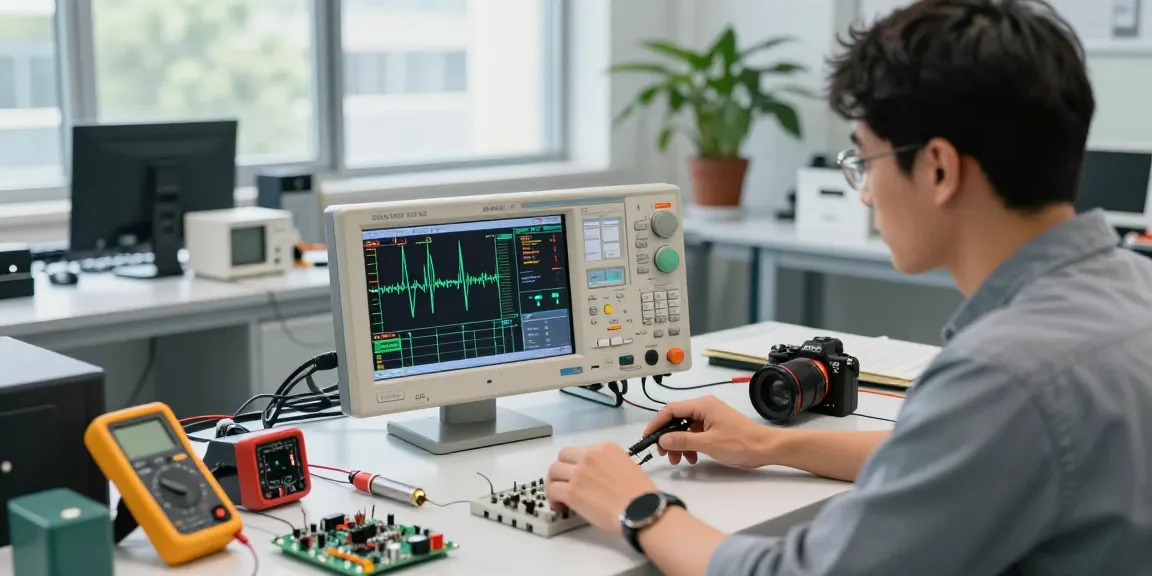
Understanding the Digital Oscilloscope
In the world of electronics, precision and accuracy are paramount, and one tool that has become essential for engineers and hobbyists alike is the digital oscilloscope. The digital oscilloscope, 4 channel oscilloscope serves as a window into electrical signals, allowing users to visualise voltage as a function of time. This technology has evolved significantly, providing myriad features that cater to various applications, from simple waveform analysis to complex signal troubleshooting.
What is a Digital Oscilloscope?
A digital oscilloscope is an electronic test instrument that captures and displays waveform signals. Unlike its analog predecessors, which use cathode ray tubes, digital oscilloscopes convert the incoming signals into digital data, allowing for more intricate processing and analysis. This conversion enables features such as advanced triggering, waveform storage, and intricate measurements that are crucial for today's sophisticated electronic applications.
Benefits of a 4 Channel Oscilloscope
The Hanmatek DOS1104, as a 4 channel oscilloscope, provides significant advantages over 2-channel models. Users are empowered to observe multiple signals simultaneously, which is indispensable for comparative analysis in complex systems. For example, when diagnosing circuit interactions, being able to view multiple waveforms at once allows for immediate insights into timing relationships and signal integrity.
Main Components and Features Explained
- Input Channels: The primary differentiator of a 4-channel oscilloscope, each channel can be independently controlled and scaled to view different signals.
- Sampling Rate: A higher sampling rate allows for clearer and more accurate waveform capture, crucial for detecting transient events.
- Display Quality: High-resolution displays enhance readability and facilitate detailed analysis of waveforms.
- Storage Options: Many digital oscilloscopes allow for saving waveforms to USB drives or internal memory, making data sharing convenient.
Applications of Digital Oscilloscopes
Use in Electronics Development
In electronics development, oscilloscopes are invaluable for design validation, testing prototypes, and troubleshooting. Engineers often rely on oscilloscopes to measure signal integrity and ensure that new designs function as intended. For instance, when developing a new microcontroller, an engineer might use the DOS1104 to verify clock signals and data transmissions across its channels.
Importance in Industrial Maintenance
In industrial settings, oscilloscopes are critical for preventative maintenance. By regularly checking machinery signals, technicians can preemptively identify issues before they escalate into costly breakdowns. The capability to monitor multiple inputs simultaneously enables comprehensive diagnostics of complex systems such as motors and power supplies, ensuring operational efficiency.
Educational Applications for Students
In an educational context, digital oscilloscopes serve as a hands-on learning tool for students in electronics and engineering courses. These instruments enable students to observe real-time signals, propelling their understanding of theoretical concepts into practical application. Engaging with tools like the Hanmatek DOS1104 fosters technical proficiency essential for future careers in engineering.
How to Use the Hanmatek DOS1104 Oscilloscope
Step-by-Step Setup Instructions
- Unbox the oscilloscope and connect the power supply.
- Attach the probes to the oscilloscope and the electronic circuit or device under test.
- Power on the oscilloscope and select the appropriate channel settings.
- Adjust the time base and voltage scale to capture the desired waveform.
- Observe and analyse the waveform displayed on the screen.
Basic Functionality and Controls
The Hanmatek DOS1104 features intuitive controls, allowing users to make quick adjustments to settings like vertical and horizontal scales. The user interface is designed to simplify navigation, making it accessible even for beginners. Key controls include triggering options, which can stabilise waveforms for better visibility, and measurements that display amplitude, frequency, and rise time directly on the screen.
Advanced Features and Options
Beyond basic functionality, the DOS1104 includes advanced features such as math operations to perform calculations on the waveforms and deep memory to capture long sequences of data. Furthermore, this oscilloscope supports various triggering modes, such as edge triggering, which allows for capturing infrequent or complex events with accuracy.
Comparative Analysis with Competitors
Performance Metrics of Leading Models
When comparing the Hanmatek DOS1104 with other models in its class, performance metrics play a significant role. Competitors may offer different bandwidths, sample rates, and features which can affect usability for specific applications. For instance, while some may boast higher bandwidth capabilities, the overall value presented by the DOS1104 in terms of cost versus features often positions it as a preferable choice.
Price and Value Comparison for 2026
In 2026, pricing for oscilloscopes remains competitive, but the Hanmatek DOS1104 stands out not only for its price but also for its features. The ability to capture and analyze multiple channels simultaneously at an economical rate makes it a valuable tool for both professional and educational use.
User Reviews and Feedback Insights
User feedback often reveals the practical benefits and limitations of the Hanmatek DOS1104. Many users commend its portability and versatility, noting that it performs exceptionally well under both lab and field conditions. However, some feedback points to a desire for additional features, such as enhanced software integration for data analysis, which could further benefit users looking for deeper insights.
Future Trends in Oscilloscope Technology
Predicted Advancements by 2026
Looking forward, oscilloscopes are on a trajectory of rapid technological advancement. The integration of artificial intelligence for predictive analysis and automated diagnostics is expected to revolutionise how engineers and technicians use these tools. As software continues to evolve, users will likely see improvements in user interfaces, making them even more intuitive.
Incorporating AI into Oscilloscope Design
Artificial intelligence in oscilloscope design could enhance data analysis capabilities, enabling the device to automatically identify anomalies in waveforms and suggest potential troubleshooting steps. This integration will not only save time but also improve accuracy in diagnostics, particularly in complex systems where human error is a concern.
Emerging Technologies and Their Impact
Emerging technologies such as IoT (Internet of Things) and advanced signal processing are set to redefine how oscilloscopes function. As more devices become interconnected, oscilloscopes will need to adapt to measure and analyse signals from a variety of sources efficiently. This shift towards comprehensive connectivity will require oscilloscopes to incorporate more sophisticated data management features.
What are the advantages of using a 4-channel oscilloscope?
The primary advantage of using a 4-channel oscilloscope is the ability to monitor and compare multiple signals simultaneously. This feature is essential for applications involving complex interactions, such as in mixed-signal designs. It allows engineers to visualise relationships between inputs and outputs, which is crucial during testing and development.
How do I troubleshoot common issues with digital oscilloscopes?
Troubleshooting common issues with digital oscilloscopes typically involves checking connections, ensuring the correct settings are applied, and verifying that the oscilloscope is functioning correctly. If the device fails to display a signal, ensure that the probes are properly connected and that the voltage levels are appropriate for the settings used.
Can I use a digital oscilloscope for field testing?
Yes, many digital oscilloscopes, including the Hanmatek DOS1104, are designed specifically for portability, making them excellent for field testing. Their lightweight design and operation capabilities allow technicians to perform diagnostics on-site without compromising performance.
What to look for in a portable oscilloscope?
When selecting a portable oscilloscope, consider factors such as bandwidth, sample rate, battery life, and ease of use. It's also essential to evaluate the number of channels and any additional features that may be beneficial for your specific applications, such as data export options and built-in analysis tools.
Are there specific safety guidelines when using oscilloscopes?
Yes, there are several safety guidelines to follow when using oscilloscopes. Always ensure that the input voltage does not exceed the maximum rating, and double-check that grounding is properly executed to prevent electric shock. It’s also advisable to avoid touching live circuits without appropriate protective equipment.